
At Redwood Outdoors, heat therapy is viewed not merely as a luxury, but as a core health practice. Over the past few years, our team has tested dozens of recovery setups—ranging from low-cost portable home saunas and steam tents to luxury indoor installations.
Whether evaluating a dry sauna for home use, an outdoor barrel sauna, or a full steam and sauna setup, finding the best home sauna comes down to long-term performance, lumber quality, and electrical safety.
This review covers the rise of Redwood Outdoors, real-world testing data, operational costs, DIY assembly, and a direct market comparison to help you choose the right unit for your space.
The History and Rise of Redwood Outdoors
Founded in Kent, Washington, by Killian Lannen and Nicholas Jensen, Redwood Outdoors began as a direct response to a gap in the North American wellness market. While Scandinavian and Baltic regions have maintained a backyard sauna culture for generations, the U.S. market historically offered limited choices: cheap, thin-walled portable home saunas or custom-built indoor home saunas costing tens of thousands of dollars.
Redwood Outdoors scaled by adopting Nordic Thermowood and sustainably sourced Canadian Cedar. By thermally modifying timber (baking the wood at high temperatures to remove moisture and organic nutrients), they created dimensional lumber that resists decay, warp, and rot in harsh outdoor climates.
By shipping pre-cut, grooved DIY home sauna kits directly to residential driveways, they reduced logistics costs and made permanent, outdoor dry saunas accessible to homeowners looking to upgrade their health routines.
Understanding the Options: Infrared, Dry Sauna, and Steam
When shopping for an at-home sauna, buyers often confuse heat delivery methods. The table below outlines how these technologies compare for home use:
| Sauna Type | Typical Operating Temp | Heating Mechanism | Plumbing Required? | Common Form Factor |
| Home Dry Sauna (Traditional) | 160°F – 195°F+ | Electric (Harvia) or Wood Stove heating air and rocks | No (water is poured manually onto rocks) | Outdoor Barrels, Cabin Saunas, Indoor Cedar Rooms |
| Home Infrared Sauna | 120°F – 150°F | Carbon/Ceramic heaters emitting Far or Full Spectrum IR waves | No | Indoor Cabin Kits, Compact Pop-Up Enclosures |
| Home Steam Room / Steam Sauna | 110°F – 120°F (100% Humidity) | Steam generator boiling water into an enclosed space | Yes (Drainage & dedicated water line required) | Tiled Enclosures, Acrylic Shower Steam Combos |
| Steam and Sauna for Home (No Plumbing) | 100°F – 130°F | Manual fill water reservoir steaming inside a fabric tent | No | Portable Home Sauna Tents, Zipper Units |
For high-heat longevity, outdoor resistance, and classic Finnish sauna culture, traditional dry saunas for home use remain the industry standard.
Comprehensive Review: Redwood Outdoors Thermowood Barrel Sauna
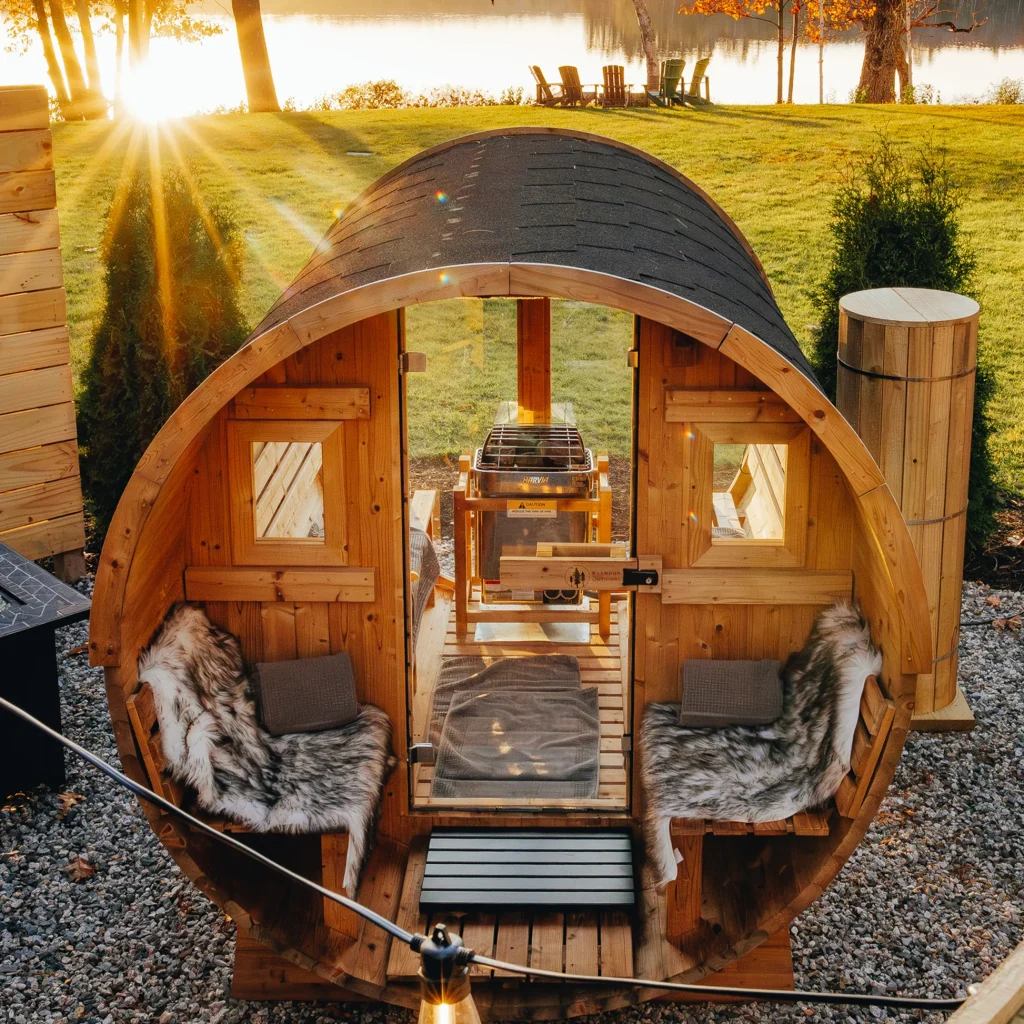
Our team assembled, wired, and tested the Redwood Outdoors 6-Person Extra-Wide Thermowood Barrel Sauna equipped with an 8kW Harvia electric heater over a four-month period.
Redwood Outdoors Barrel Sauna Specifications| Specification | Detail |
| Core Material | Scandinavian Thermowood / Red Cedar |
| Heating Unit | 8.0 kW Harvia Electric Heater |
| Power Requirements | 240V / 40-Amp Single Phase |
| Target Temperature | Up to 195°F (90°C) |
| Seating Configuration | Two-Tier / Ergonomic Bench Staves |
| Assembly Duration | 5 to 8 Hours (Two Adults) |
1. Material Quality & Construction
The Thermowood planks fit together using a precision ball-and-socket tongue-and-groove system. Unlike basic pine kits found at massive retailers, Thermowood exhibits minimal expansion and contraction when exposed to rain, ice, or intense sun. Stainless steel bands secure the barrel, allowing tight seal adjustments across seasons.
2. Heating Performance & Thermal Retention
Equipped with an 8kW Harvia heater, the sauna heated from an ambient 45°F up to 185°F in approximately 45 minutes. Throwing water over the included sauna rocks creates an immediate vapor blast (löyly) without dropping the room’s base temperature.
3. Ergonomics & Interior Space
The circular barrel design promotes natural air circulation, pushing rising hot air back down along the curved walls. The two-tier bench system lets users move to lower benches if the top tier heat feels too intense.
Technical Comparison vs. Competitors
When searching for the best at home sauna, home buyers frequently evaluate brand names like Sun Home Saunas, direct-to-consumer suppliers, or big-box stores like Costco and Home Depot.
Below is a technical breakdown of leading options in the home sauna market:
| Feature / Metric | Redwood Outdoors (Barrel) | Sun Home Saunas (Infrared) | Costco / Home Depot Kits (e.g., Almost Heaven) | Budget Portable Home Sauna |
| Primary Type | Outdoor Dry Sauna (Traditional) | Indoor/Outdoor Infrared | Indoor/Outdoor Dry Sauna | Portable Steam / Far-Infrared Tent |
| Wood / Build Material | Nordic Thermowood or Red Cedar | FSC-Certified Cedar / Hemlock | Standard Western Red Cedar / Pine | Polyester Fabric / PVC Frame |
| Max Temperature | 195°F+ (90°C+) | 165°F (74°C) | 180°F – 190°F | 115°F – 130°F |
| Electrical Supply | 240V / 30-50A Dedicated Breaker | 120V or 240V (Model Dependent) | 240V Dedicated Breaker | Standard 120V / 15A Household Outlet |
| Plumbing Needed? | No | No | No | No (Manual Fill Basin) |
| Price Range | $4,500 – $8,500 | $5,000 – $9,000 | $3,500 – $6,000 | $150 – $500 |
| Lifespan Expectancy | 15–25+ Years | 10–15 Years | 10–20 Years | 1–3 Years |
DIY Installation, Plumbing, and Electrical Setup
Is DIY Assembly Feasible?
Yes. Redwood Outdoors kits are engineered specifically for home DIY setup. All lumber is pre-cut, grooved, and numbered.
- Time Required: 5 to 8 hours for two adults.
- Tools Needed: Rubber mallet, cordless drill, level, socket wrench set, and step ladder.
- Base Requirements:Must be positioned on a firm, level surface—such as a concrete pad, gravel bed, or reinforced deck.Placing a 900+ lb wet-weight sauna directly on soil or grass will cause uneven settling.
DIY Home Sauna Installation Timeline
| Process Phase | Timeline & Details |
| Hour 1–2: Base Prep | Site clearing, leveling, and cradle beam layout |
| Hour 3–5: Barrel Assembly | Stave placement, barrel closure, and stainless steel banding |
| Hour 6–7: Interior & Door | Bench installation, front/back wall mounting, and glass door setup |
| Hour 8+: Electrical Connection | Electrician hardwires 240V line and Harvia heater unit |
Plumbing & Water Requirements
Traditional dry saunas require zero plumbing. Water for steam is manually carried in a wooden bucket and splashed over the heated rocks using a ladle.
If you want a home steam room with automated continuous humidity, dedicated supply lines and drainage systems are mandatory—adding significant plumbing costs.
Electrical Requirements & Running Costs
A traditional outdoor or indoor dry sauna cannot run on a standard 120V household plug.
- Voltage:Requires a dedicated 240V line wired directly to your breaker box with 8/2 or 6/2 copper wire.
- Hardwiring:The Harvia electric heater must be installed by a licensed electrician.
- Electrician Cost: Typically runs between $600 and $1,500, depending on distance from your main panel.
| Cost Metric | Value |
| Heater Rating | 8.0 kW |
| Pre-Heat + Session Time | 1.5 Hours total |
| Energy per Session | 12 kWh |
| Average US Utility Rate | ~$0.16 per kWh |
| Cost per Session | ~$1.92 |
| Usage Frequency | 4 Times per Week |
| Estimated Monthly Cost | ~$30.72 / Month |
How to Use Your Home Sauna Safely
To get the most out of an at-home dry sauna session, we follow this simple protocol:
- Hydrate First: Drink 16–24 oz of water before stepping inside.
- Preheat the Room: Set the timer on your Harvia heater to start 40 minutes before your planned session. Target a interior temperature of 160°F–180°F.
- Layer with Towels: Sit on a clean cotton towel to preserve bench wood from body oils and sweat.
- Manage Humidity (Löyly): Pour one ladle of water over the hot rocks every 5–10 minutes to increase sweat response without dropping ambient room heat.
- Contrast Therapy (Optional): Follow a 15-minute hot sauna session with a cold shower or cold plunge, rest for 5 minutes, and repeat for 2 to 3 cycles.
Reddit & Social Media Perspective: What Users Are Saying
We analyzed discussions across subreddits like r/Sauna, r/HomeGym, and r/Biohackers to extract unvarnished user feedback on Redwood Outdoors saunas.
The Positives
- Lumber Integrity: Users frequently highlight that Thermowood holds up significantly better against mold and weathering than non-treated white pine kits sold at box stores.
- Aesthetics: The visual presence of a cedar or Thermowood barrel in backyards garners universal praise on social media platforms.
- Customer Support: Post-purchase customer care from their Washington office receives consistent positive marks for replacing damaged staves promptly during shipping.
The Critiques
- Height & Gradient Heat (Barrel Design): Reddit sauna purists often note that barrel shapes can create a temperature gradient where feet remain cooler than your head. Raising foot benches or opting for their flat-ceiling cabin models remedies this.
- Extra Costs: Buyers caution that the initial product price does not reflect total cost. Budgeting for shipping, bitumen roof shingles, base level gravel, and professional electrician wiring is necessary.
Verdict: Is Redwood Outdoors Worth It?
If you want an authentic high-heat dry sauna experience that withstands outdoor weather, Redwood Outdoors provides exceptional build quality, heat performance, and aesthetic appeal.
While portable home saunas or budget infrared cabins offer lower price entry points, they cannot match the high heat, thermal mass, and long lifespan of a thermally modified lumber kit. For homeowners seeking a balance of price, performance, and durability, Redwood Outdoors is one of the top choices on the market today.
Frequently Asked Questions (FAQ)
What is the best type of wood to use for a home dry sauna?
Cedar (Red or White) and Scandinavian Thermowood are top choices. Cedar contains natural oils that resist insects and moisture, while Thermowood is baked to eliminate rot risk and increase thermal efficiency. Avoid untreated softwoods like pine, which can warp or bleed sap at high temperatures.
Can I install an outdoor home sauna on my wooden deck?
Yes, provided your deck can safely support the weight. A typical 6-person barrel sauna weighs between 800 to 1,200 lbs dry. Consult a general contractor to ensure your deck joists are structurally rated for concentrated loads before installation.
What is the difference between an infrared home sauna and a traditional dry sauna?
Traditional dry saunas heat the air around you using electric heating elements or wood stoves, reaching temperatures between 160°F and 200°F+. Infrared home saunas use light waves to heat your body directly at lower temperatures (120°F–150°F). Traditional saunas allow you to create steam by adding water to rocks, which is not possible in infrared units.
Do I need dedicated plumbing for an at-home sauna?
No. Traditional dry saunas and infrared units require no water hookups or drainage lines. Dedicated plumbing is only required if you are installing an automated, high-humidity home steam room.
How much does an electrician charge to wire a home sauna?
Wiring a 240V hardwired sauna heater typically costs between $600 and $1,500. Factors affecting the final price include the distance from your main panel to the sauna site, panel capacity, and whether underground conduit trenching is required.